
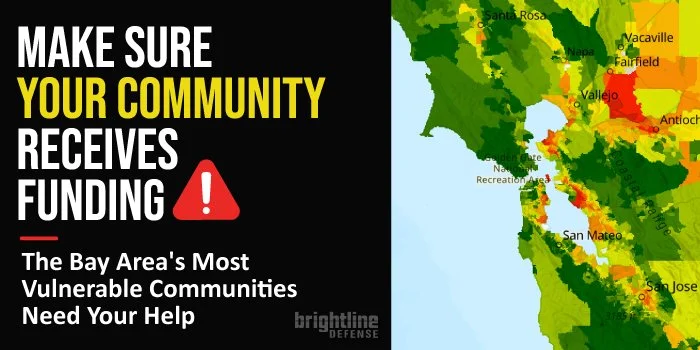
CalEnviroScreen (CES) is California's official environmental justice mapping tool. It determines which communities qualify as "Disadvantaged Communities" and therefore receive billions in funding for housing, clean energy, public health, and workforce programs.
Draft CES 5.0 fails to properly account for cumulative burdens in under-resourced Bay Area communities, including neighborhoods in Eastern SF, the North, South, and the East Bay.
If these communities are undercounted, they risk losing eligibility for critical equity-based funding for years to come.
The official OEHHA public comment period has closed, but the fight is not over. Add your name to urge Governor Newsom and state leaders to correct CalEnviroScreen 5.0 so Bay Area communities are not erased from eligibility for critical funding and protections.
Add your name to urge Governor Newsom and Secretary Garcia to correct CES 5.0 before it is finalized.
-
Governor Newsom,
The public comment period for Draft CalEnviroScreen 5.0 has closed, but California still has time to correct this flawed map before it is finalized.
CalEnviroScreen is not simply a mapping tool. It is the primary mechanism California uses to identify Disadvantaged Communities (DACs) and determine eligibility for more than $12.8 billion in equity-focused investments across housing, clean energy, workforce development, and public health programs.
Because CalEnviroScreen designations directly influence regulatory implementation and funding allocation, methodological accuracy is essential.
Draft CalEnviroScreen 5.0 fails to appropriately map several dense urban neighborhoods in the Bay Area, including South of Market (SoMa), the Tenderloin, the Mission District, Chinatown, and Bayview–Hunters Point.
Our message is clear: We are here.
Our communities face overlapping environmental exposures, housing cost burdens, linguistic isolation, and economic vulnerability. As a region, the Bay Area also loses key census tracts in this latest iteration.
Independent research and extensive press coverage have highlighted longstanding limitations in how CalEnviroScreen has represented dense, urbanized regions, including the Bay Area. When data tools undercount these burdens, communities risk losing eligibility for programs explicitly designed to address inequity.
CalEnviroScreen must accurately reflect the realities of the communities it is intended to serve. Equity-based funding depends on accurate designation.
We urge you to direct state agencies to correct these flaws before CalEnviroScreen 5.0 is finalized.
Sincerely,
[Signers]